Technology
Citizen Participation for the Roll Out of Digital National ID in Jamaica
Project Team: Denique Soutar, Glen Henry, Matthew McNaughton (SlashRoots)
Geography: Caribbean
Summary: As Jamaica rolls out its national digital ID system, SlashRoots is seeking to shape the supporting ecosystem so that it is inclusive and rights-respecting. In 2024, SlashRoots will host a series of citizen participation opportunities including dialogues and knowledge-sharing with members of the public, civic groups, regional and international groups, policy-makers and implementers. Key to this process, SlashRoots will co-create accessible, co-designed, illustrative, plain-language design patterns, documentation of the key issues, proposals, policies, and implementation decisions. Learn more here.

Experimental Questions
How might citizens (rights holders) inform the design and implementation of Jamaica’s national digital ID system?
How might citizens (rights holders) easily learn about and engage with key issues, proposals, policies and implementation decisions related to national digital ID systems?
How might organizations and governments (duty-bearers) better incorporate feedback from their stakeholders as they implement digital public infrastructure (DPI) systems?
Methods & Themes
-
In 2019, the first draft of the National Identification and Registration Act (NIRA) was struck down as unconstitutional by the Supreme Court of Jamaica. During the Jamaican government’s attempt to re-introduce a revised bill, SlashRoots co-founded the NIDS Focus coalition. This group consists of civil society groups and individuals representing a range of local, regional and international life experiences and expertise in law, computer science and human rights. This allowed us to identify and illustrate in plain language the different ways in which the legislation would impact everyday scenarios, and advocate for rights-respecting best practices to inform the legislation.
-
The knowledge and insights of citizens are valuable resources for government decision-makers, but are often overlooked as such. Facilitating public participation can be time-consuming and difficult, as can drawing actionable insights from public engagement activities. As a result, engagement activities often devolve into merely informing and educating the public, rather than also learning from them. This project seeks to take design tools and techniques and develop them to help make citizen participation more trusted, collaborative, effective and sustainable for both the public and decision-makers.
-
Storyboards are design tools borrowed from filmmaking. They are a series of illustrations and descriptions often used to explore and communicate how people will interact with a digital product or service in everyday life. Design patterns are used in architecture, digital design, and application development to record and share the key features of repeatable solutions to common problems. Storyboarding helped to explain the key issues and suggestions that anchored the NIDS Focus coalition’s partly successful recommendations for addressing some of the weaknesses in the digital ID legislation. SlashRoots seeks to further adapt storyboarding and design patterns, first to help the Jamaican public to continue engaging the government on legislation, regulations and emerging norms around the use of the digital ID system, and ultimately to help citizens elsewhere to engage with their governments on digital initiatives.
-
Service Design involves planning and organizing people, infrastructure, communication, and material components of a service to improve the quality of the interaction between service providers and beneficiaries, and the quality of service outcomes. Service Design best practice relies on evidence to inform planning, paying special attention to the qualitative experiences of the people who use the service. Service design tools and techniques can help to ensure that the services associated with the national ID system work equitably not just on paper, but in practice.
Pathway to Transform International Governance
Jamaica, like many countries across the Caribbean and the wider world, stands at a critical juncture where strategic policy making in Digital Public Infrastructure (DPI) can unleash transformative opportunities across various sectors. Rapid global digital transformation—including national digital ID systems and central digital currencies, among other projects—is reshaping economies, governance, and societal interactions. In this context, effective DPI policies can drive economic growth, improve public services, and enhance social inclusion, ensuring that all citizens benefit from the digital revolution.
We believe that a rights-based, people-centric approach to building digital systems and the policies that govern them is necessary to maximize the national-scale benefits of digital systems while minimizing their harms. We started this work during the public debating of Jamaica’s draft national digital ID legislation, by co-founding the NIDS Focus coalition. The diverse life experiences and expertise of this civil society group allowed us to develop illustrated, plain-language documentation of key issues and recommendations that enhanced the effectiveness of our advocacy. At the global level, we co-founded the more than 50-member Civil Society Coalition on Digital Identity and Human Rights, and are represented on the UN Working Group for the Universal Safeguards for Digital Public Infrastructure.
A rights-based, people-centric approach to digital transformation involves effective citizen participation: citizens must be able to understand the impact of proposed systems and policies on their lives, clearly represent their concerns and recommendations to decision-makers, and competently advocate for their rights. Additionally, decision-makers need to recognize citizens as experts in their own lived experiences, and actively seek citizen participation as a means of building and maintaining systems that truly work for them.
Tools and techniques used in the design of digital products and services have been used to help citizens explore and speak to the implications of Jamaica’s national ID legislation, and will be used to help citizens shape the regulations and emerging norms around the use of the digital ID system. These will be further developed into materials that citizens worldwide can use to engage with digital transformation.
Resources & Updates
NIDS Focus Coalition presentation to Jamaica Parliament Joint Select Committee
On April 6 and 9, 2021, the NIDS Focus Coalition presented its recommendations on the National Identification and Registration Act 2020 proposing a new digital ID to Jamaica's Parliament.
-
This video includes the presentation of both days, led by Matthew McNaughton from SlashRoots and Rodje Malcolm from Jamaicans for Justice. Besides these organizations, the full coalition includes National Integrity Action, the Combined Disabilities Association, the Jamaica Computer Society, Access Now, Open Society Foundations – Justice Initiative, the Jamaica Youth Advocacy Network, the Caribbean Vulnerable Communities Coalition, the Jamaica Network of Seropositives, JFLAG, Stand Up For Jamaica, and the Jamaica Accountability Meter Portal. You can watch the full Joint Select Committee sessions, including other civil society organizations apart from the NIDS Focus Coalition, here:
Joint Select Committee on The National Identification and Registration Act 2020 - April 6, 2021
Joint Select Committee on The National Identification and Registration Act 2020 - April 9, 2021
Learn more information about the work of the NIDS Focus Coalition at https://nidsfocus.com/
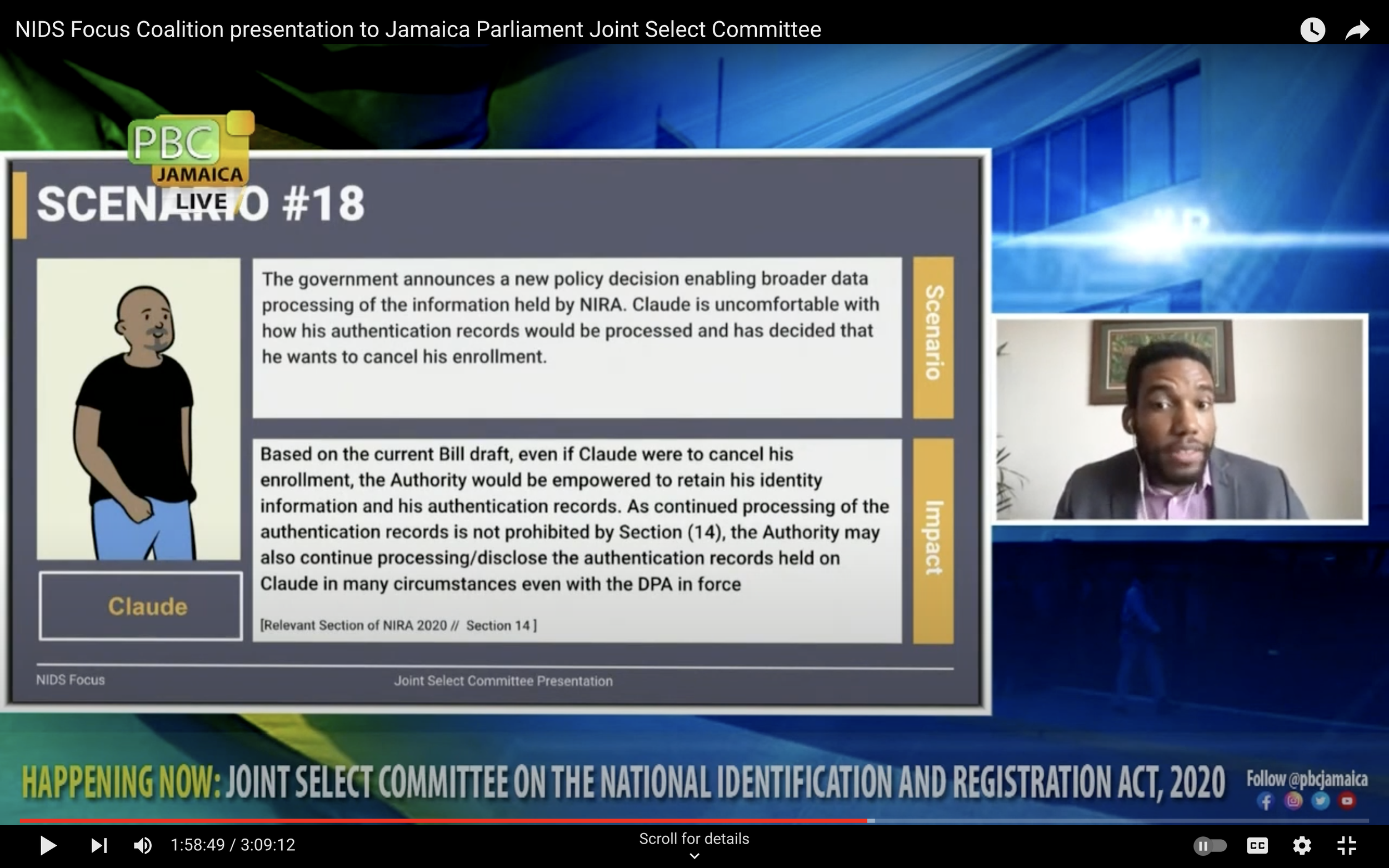
NIDS Focus Joint Select Committee Presentation
On April 6 and 9, 2021, the NIDS Focus Coalition presented its recommendations on the National Identification and Registration Act 2020 proposing a new digital ID to Jamaica's Parliament.
-
Significant components of the legal framework for NIDS have been left to future regulations. Key areas include the process of application and enrolment, how authentication will be managed, how verification will be conducted, the manner in which accredited third parties will be managed, the business processes associated with NIDS, and other components. While it is not controversial to relegate operational matters to subsidiary legislation, in some cases the Bill does not establish foundational clarity and direction. We recommend improvements to these specific areas in later sections. However, given the significance of the matters to be prescribed in future regulations and the far-reaching implications of NIDS as a novel system of legal identification, we recommend that: (a) The government commit to publishing the draft regulations ahead of their consideration in Parliament and allow for public input on their contents. (b) The Parliament and the wider society receive the draft regulations prior to the passage of the Act, given that the manner in which the Bill is drafted requires an understanding of the regulations to interpret the Bill properly. (c) The government publishes technical and operational documents that will guide key processes within NIDS and allow for public input. Many of the national identification systems lauded by the GOJ as references and exemplars, such as those established in Estonia and India, published multiple white papers and technical specifications to provide greater transparency and engage the private sector and civil society in dialogue.
Interpretation of this Bill is incomplete without the Data Protection Act’s regulations in place. The Government of Jamaica has decided to proceed with the NIRA Bill's formulation and the implementation of NIDS ahead of the operationalization of the Data Protection Act (DPA) or even the appointment of the Office of the Information Commissioner. In the case of the NIDS, institutional reforms(such as those at the Registrar General’s Department) and the procurement of systems from third parties have even preceded the Bill's passing before this Joint Select Committee. We believe that this is suboptimal sequencing for establishing a NIDS best positioned to achieve the policy objectives, create confidence in the population, and minimize the risks of replicating the harms caused by biometric-based identity systems in other jurisdictions. Core functions of the Authority contained in the Bill, such as the disclosure of identity information to third parties, or the manner in which it organizes and secures the databases of sensitive personal information would be shaped by the Data Protection Act’s regulations. Any analysis of the Bill, therefore, cannot fully interpret the adequacy, compliance, or appropriateness of the Bill's proposed safeguards without an operational data protection framework.
NIDS should not be made “de facto" mandatory by requiring it to access basic goods and services. People should not face the prospect of social exclusion because of non-enrolment, nor should their conditions be made more difficult in order to influence their enrolment. This includes making certain services contingent on enrolment in NIDS. This Bill and subsequent regulations must be clear to not have the effect of degrading or introducing limitations on existing identification options Jamaicans have available to them today. It is important to note that this does not negate the new avenues for identity verification that NIDS will enable due to the features of the system. However, these avenues must be viewed as additive, expanding access to legal identification for all Jamaicans.
Website: NIDS Bill Issues
NIDS Focus has submitted a review of the proposed National Identification and Registration Act (NIDS Bill) to Parliament. The review put forward a number of issues, points needing additional explanation, and recommendations for strengthening the Bill’s support for privacy, security, and other rights.
On this website, you can:


Meet the Team
-

DENIQUE SOUTAR
CO-LEAD
Denique Soutar is a Senior Service Designer at the SlashRoots Foundation, where she uses human-centered design to address civic and social problems. She helps the team define and explore problem spaces, planning and managing the research, communication and prototyping activities that turn who’s, what’s, how’s and why’s into how-we-might’s. She especially enjoys those moments in the process when the team’s understanding of a problem shifts and insights are most likely to emerge.
-

GLEN HENRY
CO-LEAD
Glen Henry is a passionate Software Developer and skilled Project Manager at SlashRoots with a deep appreciation for the intersection of art and technology. With his unique background, Glen efficiently manages resources, timelines, and stakeholders amid the complexities of software development. His work showcases the powerful synergy between project management, creative problem solving, and software development, highlighting the importance of effective project management in bringing creative visions to life.
-

MATTHEW MCNAUGHTON
CO-LEAD
Matthew McNaughton is a Principal of the SlashRoots Foundation where he leads projects on practical applications of ICTs, and open and participatory governance. He also sits on the UN Working Group for the Universal Safeguards for Digital Public Infrastructure. Matthew speaks and writes regularly on open data and civic technology in the Caribbean and other emergent economies, innovative approaches to building technical capacity, and overcoming data gaps in low-resource environments.