Ideas & Actions Series.
This series highlights theory & practice ideas from the broader FORGE community of practice. The goal of the series is to create opportunities for peer-to-peer learning. Each guest speaker publishes an article in the FORGE Series in Open Global Rights (OGR) which serves as a discussion prompt for the session.
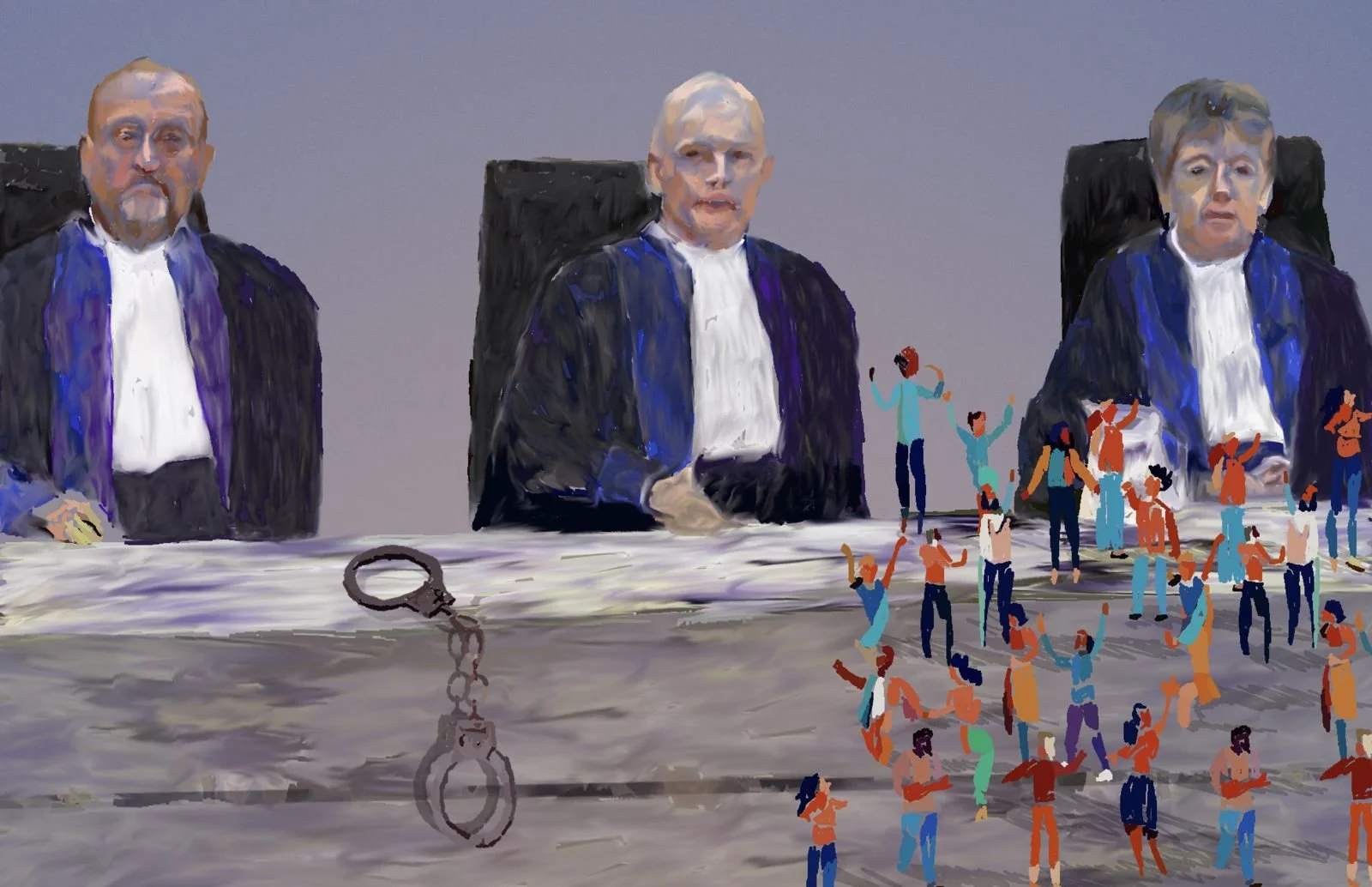
Criminalizing Human Rights
with Philip Alston
Summary: What impact does criminalizing human rights have on global human rights systems? International human rights law, international humanitarian law, and international criminal law are increasingly concerned with atrocity crimes.
As a result, the field is centering the role of judges and criminal lawyers at the expense of social movements, shining a spotlight on individuals rather than collective responsibility, reinforcing problematic North-South dynamics, and distorting resource allocations at the international level.
-
Philip Alston teaches international law, human rights law, economic and social rights, and strategic human rights litigation at NYU School of Law. As both a scholar and practitioner, he focuses in his work on the human rights dimensions of issues such as neoliberal economic policies, climate change, artificial intelligence, and poverty elimination.

Reimagining Human Rights for the Global South
with Biraj Patnaik
Summary: Why is the human rights discourse not part of the popular imagination in the global south and how have mainstream human rights organisations failed in this project? The principal problem is not how human rights have been framed but decades of privileging some rights over others; over-emphasis of legal frameworks over domestic idioms and not being able to join the dots of a million mutinies to create an overarching narrative.
The economic and moral decline of the North, emergence of a more multi-polar world run by populists and the climate crisis may well offer us another opportunity to shape this re-crafting for a more durable consensus of all rights for all people at all times.
-
Biraj Patnaik is the Executive Director of the National Foundation for India. A human rights practitioner for close to three decades, he is the former South Asia Director of Amnesty International . He was the Principal Adviser to the Commissioners of the Supreme Court of India on the right to food. A well-known human rights activist, Biraj has worked on the intersection of rights and policy, most notably on the right to food over the last two decades at the national, regional and global level. He’s is active in a number of people-centric movements in India and abroad.

Expanding beyond the human in public engagement
with Zahra Ebrahim
Summary: Movements to improve public consultation, such as using more participatory methods, collaborative design, citizen’s assemblies, have urged public institutions to see people - humans - as central partners in the decision-making process. But as cities around the world transform to accommodate over half the world’s population, who gets to decide how they evolve?
The established best practice is to engage the public - the human public - in the dialogue. But what would the more-than-human world - plants, animals, rocks, ecosystems - have to say if they were invited into the conversation?
-
Zahra Ebrahim is the Co-Founder of Monumental. She is a public interest designer and strategist, and an established bridge builder across grassroots and institutional spaces. Her work has focused on community-led approaches to policy, infrastructure, and service design. Prior to Monumental, she built and led Doblin Canada, Deloitte’s Human-Centred Design practice. In her early career, Zahra led one of Canada’s first social design studios, working with communities to co-design towards better social outcomes, leading some of Canada’s most ambitious participatory infrastructure and policy programs. Zahra has taught at OCADU, MoMA, and is currently an Urbanist-in-Residence at the University of Toronto’s School of Cities. She has been recognized as a Next City Vanguard Civic Leader, Ascend Canada’s Mentor of the Year, one of “Tomorrow’s Titans” in Toronto Life magazine, one of WXN’s Top 100 Women in Canadian Business, and most recently recognized as one of the Urban Land Institute’s WLI Champions. Zahra is currently a Board member of the Toronto Arts Council, the Canadian Urban Institute, and Board Chair for Park People. Her work has been featured across international media, and she regularly delivers speaking engagements to audiences across the country.

A new human rights education program to promote civic engagement: Human Rights Close to Home
with Sandra Sirota
Summary: A small but growing number of Human Rights Education (HRE) studies demonstrates that HRE can promote respect and encourage advocacy for the rights and dignity of all people.
Efforts to offer HRE in classrooms and communities have largely come from non-governmental organizations (NGOs), educators, and, at times, local governments. In absence of a coordinated effort from the US government, state and local initiatives have achieved some success in advancing HRE.
Building from existing efforts, how might we increasingly integrate human rights education and practical skills-building within school classrooms?
-
Sandra Sirota, EdD, is director of Human Rights Close to Home, a program of Dodd Impact, and Assistant Professor In-Residence in Human Rights and Experiential Global Learning with the Human Rights Institute at the University of Connecticut. Human Rights Close to Home (HRCH) engages educators and youth in the development and implementation of human rights education. Its goal is to encourage civic action in order to strengthen democracy and respect for human rights in our Connecticut communities and beyond. Sandra’s work explores human rights and social justice education in formal and non-formal settings in the United States and South Africa.